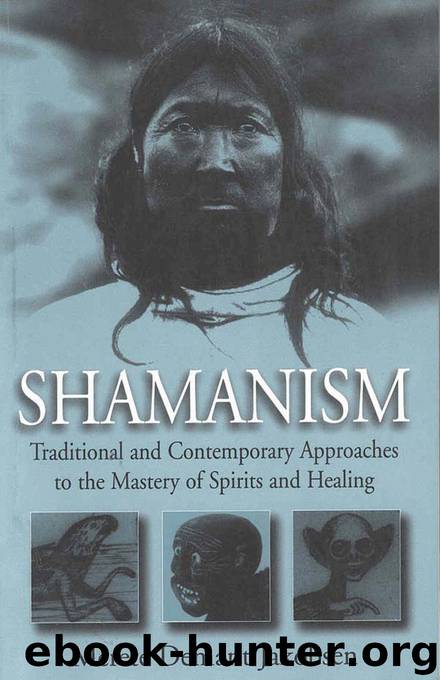
Shamanism by Merete Demant Jakobsen
Author:Merete Demant Jakobsen
Language: eng
Format: epub
Publisher: Berghahn Books
Published: 1999-04-18T04:00:00+00:00
Erkiliks
Their upper part looks like a human being, the lower like a dog. They have a hostile relationship to humans and live on the inland ice. Timerseks, Erkiliks and Kavdlunaks (Europeans) all have the same origin, they are offspring of a girl and a dog.
Gobajaks
These are women with round bellies and iron nails.
Tarajuatsiaks (1888: 115ff).
These are shadows, which are helping the angakkut.
52.Birket-Smith stresses that among the Chugach Eskimos ‘once the connection with the spirits was established, it was founded upon co-operation on so to speak equal terms and not upon a state of dependance of the shaman and superiority of his assistant spirits. A shaman was simply called kala•lik, i.e., one who has spirit(s)’ (1953: 126). Among the Iglulik Rasmussen describes an interview with a shaman: ‘Otherwise he could tell me nothing more definite about these spirits. He merely said that their power lay in their own unfathomable mysteriousness. They had appeared to him in the first instance without his asking, he had touched them, and they had thereby become his property or his servants once and for all, coming to help him whenever he called’ (1929: 38).
53.Eliade describes this lack of costume:
The shaman bares his torso and (among the Eskimo, for example) retains a belt as his only garment. This quasi-nudity probably has a religious meaning, even if the warmth prevalent in Arctic dwellings would apparently suffice by itself to explain the custom. In any case, whether there is ritual nudity (as in the case of the Eskimo shamans) or a particular dress for the shamanic experience, the important point is that the experience does not take place with the shaman wearing his profane, everyday dress. (1989: 146)
54.Thalbitzer gives a description of another instrument, a makkortaa: ‘it consists of a round, flat piece of black skin from five to five and a half centimetres in diameter, which is held tightly in the hollow of the hand, while it is struck or rapped-on with a carved wooden stick with the other hand. By aid of this little instrument the angakok produces a loud rhythmic knocking as a preliminary to his meeting with the spirits below the ground’ (1908: 458).
55.Therkel Mathiassen describes one of these stones:
an oval gneiss pebble, one side of which has been rubbed smooth through friction against something hard without actually forming facets: Thus it has scarcely been used as a whetstone, and it has no bruises as the hammer stone has. More probably it is one of those stones which the shamans employ in their séance, rubbing it against another stone with a rotating movement in order to conjure up their helping spirits. A stone of this appearance, found at Kûngmiut near Angmagsalik, was identified by Karl Andreassen, the Greenland artist and story-teller, as one of these angakoq stones. (1934: 113)
56.Christian Leden describes in a diary from 1909 the singing and dancing involved in the angakkoq’s séance. The old angakkoq Massaitsiak is facing a younger man, Ajorsilak who is carrying a piece of driftwood between his teeth. Ajorsilak stares at the old angakkoq as if to hypnotise him.
Download
This site does not store any files on its server. We only index and link to content provided by other sites. Please contact the content providers to delete copyright contents if any and email us, we'll remove relevant links or contents immediately.
Unwinding Anxiety by Judson Brewer(73415)
The Art of Coaching by Elena Aguilar(53639)
The Fast Metabolism Diet Cookbook by Haylie Pomroy(21252)
Rewire Your Anxious Brain by Catherine M. Pittman(18795)
Healthy Aging For Dummies by Brent Agin & Sharon Perkins RN(17121)
Talking to Strangers by Malcolm Gladwell(13534)
The Art of Thinking Clearly by Rolf Dobelli(10710)
Mindhunter: Inside the FBI's Elite Serial Crime Unit by John E. Douglas & Mark Olshaker(9514)
Crazy Rich Asians by Kevin Kwan(9415)
The Compound Effect by Darren Hardy(9145)
Tools of Titans by Timothy Ferriss(8590)
Periodization Training for Sports by Tudor Bompa(8414)
Becoming Supernatural by Dr. Joe Dispenza(8366)
Wonder by R. J. Palacio(8237)
Bodyweight Strength Training by Jay Cardiello(8027)
Crystal Healing for Women by Mariah K. Lyons(8003)
Change Your Questions, Change Your Life by Marilee Adams(7928)
Nudge - Improving Decisions about Health, Wealth, and Happiness by Thaler Sunstein(7850)
Therapeutic Modalities for Musculoskeletal Injuries, 4E by Craig R. Denegar & Ethan Saliba & Susan Saliba(7779)
